

1. Meaning and Definition of Criminal Law
Criminal law is the branch of law that deals with offences committed against the state, society, or the public at large. It defines acts that are considered crimes and prescribes punishments for those acts. In India, criminal law plays a vital role in maintaining public order, protecting citizens, and ensuring justice through a structured legal system.
In simple terms, criminal law identifies what constitutes a crime, who is liable, and how offenders are punished. Unlike civil disputes, criminal cases involve prosecution by the state because crimes are viewed as wrongs against society, not just individuals. Offences such as theft, assault, cheating, murder, and cybercrime fall within the scope of criminal law.
Criminal Law Definition:
Criminal law can be defined as a system of rules enacted by the state that prohibits conduct threatening public safety and prescribes punishment for such conduct.
In India, criminal law is governed primarily by:
- Bharatiya Nyaya Sanhita (earlier Indian Penal Code)
- Code of Criminal Procedure (CrPC)
- Indian Evidence Act
Procedural safeguards such as bail and anticipatory bail in India exist to protect individuals from unlawful detention. Many people search for what is anticipatory bail in criminal law because criminal law also safeguards the rights of an accused against false or motivated allegations.
Understanding criminal law is especially important before arrest or during investigation. At this stage, consulting an experienced Anticipatory Bail Advocate in Allahabad can protect personal liberty and ensure compliance with legal procedures. Renowned professionals like Advocate Azad Khan, often regarded as an Allahabad High Court best criminal advocate, assist individuals in navigating criminal law effectively and lawfully.
2. Objectives of Criminal Law
The objectives of criminal law are not limited to punishing offenders; rather, they aim to maintain social order, protect fundamental rights, and ensure justice for both victims and accused persons. Criminal law acts as a deterrent against unlawful behavior while upholding constitutional principles of fairness and due process.
One of the primary objectives of criminal law is crime prevention. By defining offences and prescribing punishments, criminal law discourages individuals from engaging in criminal activities. Another key objective is punishment, which ensures accountability and reinforces respect for the law.
Equally important is the protection of individual liberty. Legal provisions such as anticipatory bail under CrPC exist to prevent misuse of arrest powers. This is why people often seek clarity on anticipatory bail explained in simple words when facing criminal accusations.
Main Objectives of Criminal Law include:
- Maintaining law and order in society
- Deterring criminal behavior
- Punishing offenders fairly
- Protecting innocent individuals from false cases
- Ensuring justice to victims
Criminal law also focuses on rehabilitation and reform, especially in cases involving first-time or minor offenders. Courts increasingly emphasize corrective justice rather than purely punitive measures.
To effectively achieve these objectives, legal representation is crucial. An experienced criminal advocate ensures that the rights of the accused are not violated during investigation or trial. In sensitive matters involving arrest or false allegations, consulting an Anticipatory Bail Advocate in Allahabad, such as Advocate Azad Khan, can be decisive in protecting one’s freedom and legal rights before the Allahabad High Court.
3. Importance of Criminal Law in Society
Criminal law is essential for the smooth functioning of society. It establishes clear standards of behavior and consequences for violations, ensuring peace, security, and justice. Without criminal law, society would face disorder, vigilantism, and unchecked misuse of power.
One of the most important roles of criminal law is protecting citizens from harm. It addresses crimes against persons, property, and the state, ensuring that offenders are held accountable. At the same time, criminal law safeguards individuals against arbitrary actions by authorities through legal checks such as bail and anticipatory bail in India.
Criminal law also reinforces public confidence in the justice system. When laws are enforced fairly and transparently, people are more likely to trust legal institutions. Provisions like what is anticipatory bail under CrPC highlight the system’s commitment to balancing state power with individual liberty.
Why Criminal Law is Important:
- Maintains social order and discipline
- Protects life, property, and dignity
- Prevents abuse of authority
- Ensures justice for victims and accused
- Upholds constitutional rights
In modern times, the importance of criminal law has increased due to rising cybercrime, economic offences, and misuse of criminal complaints. In such situations, professional legal guidance becomes critical. Individuals often rely on the Allahabad High Court best criminal advocate to navigate complex criminal proceedings.
Legal experts like Advocate Azad Khan play a significant role in ensuring that criminal law serves its true purpose justice, not oppression especially in matters involving arrest, investigation, and anticipatory bail.
4. Evolution of Criminal Law in India
The evolution of criminal law in India reflects the country’s legal, social, and constitutional development. Ancient Indian texts like the Manusmriti and Arthashastra contained early concepts of crime and punishment. During British rule, criminal law was systematized with the enactment of the Indian Penal Code in 1860.
Post-independence, Indian criminal law evolved to align with constitutional values such as equality, liberty, and due process. Judicial interpretation expanded the scope of fundamental rights, leading to protections against arbitrary arrest and detention. This evolution gave rise to safeguards such as anticipatory bail in criminal law.
The introduction of anticipatory bail under CrPC marked a significant shift toward protecting personal liberty. It recognized that arrest should not be used as a tool for harassment or humiliation. This is why many individuals today seek clarity on anticipatory bail meaning and anticipatory bail definition.
Recent reforms, including the transition from IPC to Bharatiya Nyaya Sanhita, aim to modernize criminal law by addressing contemporary crimes and simplifying legal procedures.
Key Stages in Evolution:
- Ancient customary laws
- British codification (IPC & CrPC)
- Constitutional reforms post-1950
- Judicial expansion of human rights
- Modern criminal law reforms
Legal practitioners, especially experienced criminal advocates, have played a vital role in shaping criminal jurisprudence. Professionals like Advocate Azad Khan, practicing before the Allahabad High Court, contribute to this evolving system by defending legal rights and ensuring justice through lawful means.
5. Sources of Criminal Law in India
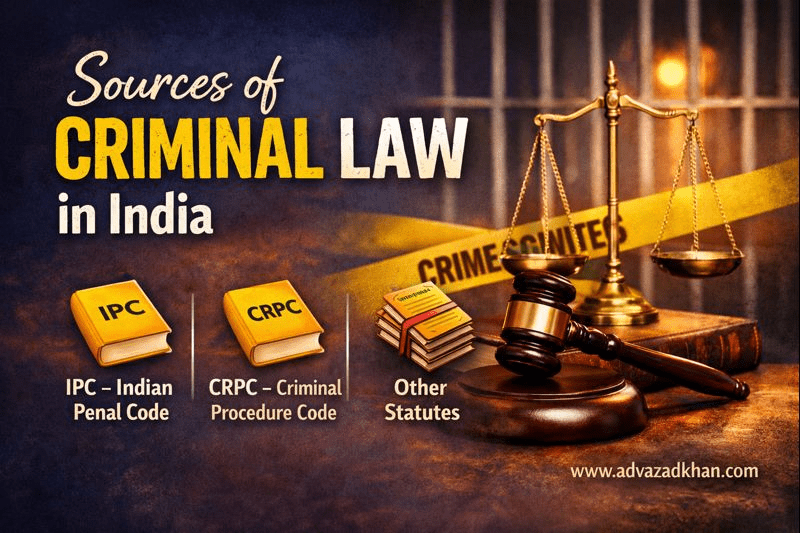
Criminal law in India is derived from multiple statutory and constitutional sources that collectively govern crimes, procedures, and evidence. These sources ensure uniform application of law and protect both societal interests and individual rights.
The primary sources of criminal law include:
- Bharatiya Nyaya Sanhita (earlier IPC): Defines offences and punishments
- Code of Criminal Procedure (CrPC): Governs arrest, investigation, bail, and trial
- Indian Evidence Act: Regulates admissibility of evidence
Among these, CrPC plays a crucial role in safeguarding liberty through provisions such as anticipatory bail in India. Many people search for what is anticipatory bail under CrPC because it is a statutory protection against arrest before custody.
Secondary sources include:
- Judicial precedents
- Constitutional provisions (Articles 20, 21, and 22)
- Legal commentaries
Judicial decisions by High Courts and the Supreme Court significantly influence criminal law interpretation. The Allahabad High Court has delivered landmark rulings on bail and anticipatory bail explained in simple words, strengthening individual rights.
For practical application of these sources, legal expertise is essential. An experienced Anticipatory Bail Advocate in Allahabad understands how to apply statutory law and precedents effectively. Advocates like Advocate Azad Khan, widely recognized as an Allahabad High Court best criminal advocate, ensure that criminal law sources are used to protect justice rather than misuse authority.
6. Difference Between Criminal Law and Civil Law
Criminal law and civil law are two fundamental branches of the legal system, but they serve very different purposes. Understanding the distinction between them is essential, especially for individuals who may be involved in legal disputes or criminal proceedings.
Criminal law deals with offences committed against the state or society as a whole. Acts such as theft, assault, cheating, fraud, and murder are considered crimes because they threaten public order and safety. In criminal cases, the state prosecutes the accused, and punishment may include imprisonment, fine, or both. Legal remedies like bail and anticipatory bail in India are available only in criminal matters.
Civil law, on the other hand, governs disputes between private individuals or entities. These disputes usually involve property, contracts, family matters, or compensation claims. The objective of civil law is not punishment but restitution or compensation to the aggrieved party.
Key Differences Between Criminal Law and Civil Law:
- Nature: Crime vs private dispute
- Parties: State vs accused | Individual vs individual
- Outcome: Punishment | Compensation or relief
- Standard of Proof: Beyond reasonable doubt | Balance of probabilities
- Bail: Applicable only in criminal law
Another important difference lies in personal liberty. In criminal law, arrest is possible, which is why protections like what is anticipatory bail in criminal law become crucial. Many individuals facing false allegations seek guidance from an experienced Anticipatory Bail Advocate in Allahabad to prevent unnecessary detention.
Legal experts such as Advocate Azad Khan, often regarded as an Allahabad High Court best criminal advocate, help clients understand whether their matter falls under criminal or civil law and take appropriate legal action accordingly.
7. Types of Crimes Under Criminal Law
Criminal law classifies crimes into various categories based on their nature, seriousness, and impact on society. This classification helps courts determine jurisdiction, procedure, and punishment.
One major category includes offences against the human body, such as murder, assault, rape, and kidnapping. These crimes directly affect personal safety and dignity and are treated as serious offences under criminal law.
Another category is offences against property, including theft, robbery, dacoity, criminal breach of trust, and cheating. These crimes involve unlawful interference with another person’s property or financial rights.
Common Types of Crimes Under Criminal Law:
- Offences against persons
- Offences against property
- Economic and financial offences
- Cyber crimes
- Offences against the state
Economic offences such as fraud, money laundering, and corruption have increased significantly in recent years. Similarly, cyber crimes like online fraud and identity theft now form a major part of criminal litigation.
Many of these offences are non-bailable, which makes anticipatory bail meaning and anticipatory bail definition extremely relevant. In serious cases, arrest may occur at the investigation stage, prompting individuals to apply for anticipatory bail under CrPC.
Understanding the type of crime involved is essential for legal strategy. An experienced criminal advocate evaluates the nature of the offence and advises on legal remedies. Individuals accused of serious offences often approach an Anticipatory Bail Advocate in Allahabad, such as Advocate Azad Khan, to secure legal protection and defend their rights before the Allahabad High Court.
8. Cognizable and Non-Cognizable Offences
Criminal law further classifies offences into cognizable and non-cognizable offences, based on the powers granted to the police for investigation and arrest. This distinction plays a crucial role in criminal proceedings.
Cognizable offences are serious offences where the police can register an FIR, investigate the case, and arrest the accused without prior court permission. Examples include murder, rape, kidnapping, and serious fraud. Due to the immediate risk of arrest in such cases, individuals often seek clarity on what is anticipatory bail under CrPC.
Non-cognizable offences are less serious in nature. In these cases, the police cannot arrest without a warrant and require court permission to investigate. Examples include defamation, simple assault, and public nuisance.
Key Differences:
- Cognizable: Police action without court approval
- Non-cognizable: Court approval required
- Severity: Serious vs comparatively minor
In cognizable offences, misuse of arrest powers is a real concern. This is where anticipatory bail explained in simple words becomes relevant it allows a person to seek protection from arrest even before being taken into custody.
Courts, including the Allahabad High Court, closely scrutinize arrest procedures to prevent abuse of authority. Consulting an experienced Anticipatory Bail Advocate in Allahabad ensures that legal remedies are exercised promptly.
Professionals like Advocate Azad Khan, recognized as an Allahabad High Court best criminal advocate, regularly handle cognizable offence matters and help clients secure anticipatory bail to safeguard their personal liberty and constitutional rights.
9. Bailable and Non-Bailable Offences
Bailable and non-bailable offences are another important classification under criminal law, directly affecting an accused person’s right to liberty. This classification determines whether bail can be claimed as a right or granted at the court’s discretion.
Bailable offences: are less serious offences where the accused has a legal right to be released on bail. The police or court must grant bail once the required conditions are fulfilled. Examples include minor theft, simple hurt, and public nuisance.
Non-bailable offences: are serious crimes where bail is not a matter of right. In such cases, the court considers factors like the nature of the offence, evidence, criminal history, and risk of absconding before granting bail.
Key Points:
- Bailable offences → Bail as a right
- Non-bailable offences → Bail at court’s discretion
- Serious offences → Higher scrutiny
In non-bailable cases, individuals often fear arrest and detention. This is why searches related to what is anticipatory bail in criminal law are common. Anticipatory bail in India provides a legal remedy that allows the accused to seek bail in advance.
An experienced criminal advocate plays a crucial role in presenting facts, protecting rights, and ensuring fair consideration by the court. In sensitive non-bailable cases, guidance from an Anticipatory Bail Advocate in Allahabad, such as Advocate Azad Khan, can significantly improve the chances of securing relief before the Allahabad High Court.
10. Compoundable and Non-Compoundable Offences

Compoundable and non-compoundable offences are classified based on whether the dispute can be legally settled between the parties. This distinction affects the continuation and conclusion of criminal proceedings.
Compoundable offences: are those where the victim and the accused can enter into a lawful compromise, with or without court permission. These offences are generally less serious and personal in nature, such as minor assault or defamation.
Non-compoundable offences: on the other hand, cannot be settled privately. These offences involve serious harm to society, such as murder, rape, or serious economic crimes. Once initiated, the prosecution must proceed as per law.
Examples:
- Compoundable: Simple hurt, trespass
- Non-compoundable: Murder, rape, dacoity
Even in non-compoundable offences, courts may grant bail or anticipatory bail depending on the facts of the case. This is why understanding anticipatory bail meaning and anticipatory bail definition is important even when compromise is not possible.
Legal advice is critical in determining whether an offence is compoundable and what remedies are available. An experienced Anticipatory Bail Advocate in Allahabad ensures that procedural rights are not violated and appropriate legal relief is sought.
Advocates like Advocate Azad Khan, known as an Allahabad High Court best criminal advocate, assist clients in navigating complex criminal classifications while protecting their liberty and legal interests.
11. Overview of Indian Penal Code / Bharatiya Nyaya Sanhita
The Indian Penal Code (IPC), enacted in 1860, has been the foundation of criminal law in India for over a century. Recently, it has been replaced by the Bharatiya Nyaya Sanhita, which aims to modernize criminal law in accordance with contemporary social and technological realities. Both frameworks define criminal offences, prescribe punishments, and establish principles of criminal liability.
The Bharatiya Nyaya Sanhita classifies offences into various chapters such as offences against the human body, property, state, public tranquillity, and morality. Each offence is clearly defined along with its punishment, ensuring certainty and uniformity in criminal justice administration.
One of the key features of modern criminal law is its focus on procedural fairness. While the Sanhita defines crimes, the Code of Criminal Procedure (CrPC) governs arrest, investigation, and bail. This includes protections like anticipatory bail in India, which safeguard individuals from arbitrary arrest.
Key Features of Bharatiya Nyaya Sanhita:
- Clear definition of offences
- Proportionate punishments
- Focus on victim rights
- Alignment with constitutional values
People often search for what is anticipatory bail in criminal law because substantive criminal law must work alongside procedural safeguards. Courts, including the Allahabad High Court, ensure that enforcement does not violate personal liberty.
An experienced criminal advocate understands how substantive law and procedural law intersect. Legal professionals such as Advocate Azad Khan, regarded as an Allahabad High Court best criminal advocate, effectively apply these laws to protect clients, particularly in serious criminal cases requiring anticipatory bail under CrPC.
12. Role of Criminal Courts in India
Criminal courts in India play a central role in delivering justice, interpreting criminal laws, and protecting constitutional rights. These courts ensure that offences are tried fairly and punishments are imposed in accordance with law.
The criminal court system in India is hierarchical:
- Magistrate Courts – Trial of minor offences
- Sessions Courts – Trial of serious offences
- High Courts – Appeals, revisions, and bail matters
- Supreme Court – Final appellate authority
Criminal courts also act as guardians of personal liberty. They regulate arrest, remand, and detention while granting remedies such as bail and anticipatory bail in India. Many individuals approach courts seeking clarity on what is anticipatory bail under CrPC to prevent unnecessary incarceration.
The Allahabad High Court plays a significant role in protecting individual rights through judicial review and interpretation of criminal procedure. It frequently intervenes in cases involving illegal arrest or misuse of police powers.
Functions of Criminal Courts:
- Conduct fair trials
- Protect rights of accused and victims
- Grant bail and anticipatory bail
- Interpret criminal statutes
Effective legal representation is vital before criminal courts. An experienced Anticipatory Bail Advocate in Allahabad ensures that legal arguments are properly presented and procedural safeguards are enforced. Advocates like Advocate Azad Khan, known as an Allahabad High Court best criminal advocate, regularly represent clients in complex criminal proceedings, ensuring justice and legal compliance.
13. Stages of a Criminal Case
A criminal case in India follows a structured process, ensuring fairness and due process at every stage. Understanding these stages helps individuals protect their rights and respond appropriately when facing criminal allegations.
The first stage is the commission of an offence, followed by the registration of an FIR. Once an FIR is registered, the police begin investigation, collect evidence, and record statements. At this stage, the possibility of arrest arises, which is why many people seek information on anticipatory bail explained in simple words.
After investigation, the police file a charge sheet before the court. The court then takes cognizance and begins the trial process, where evidence is examined, witnesses are cross-examined, and arguments are presented. The trial concludes with judgment and sentencing, if the accused is found guilty.
Stages of a Criminal Case:
- FIR registration
- Investigation
- Arrest and bail
- Filing of charge sheet
- Trial and judgment
Throughout these stages, legal safeguards such as anticipatory bail under CrPC protect individuals from unlawful detention. Courts ensure that arrest is not used as a punitive measure before guilt is established.
Engaging a competent criminal advocate at an early stage can significantly influence the outcome of the case. Individuals facing criminal proceedings often rely on an Anticipatory Bail Advocate in Allahabad, such as Advocate Azad Khan, to navigate each stage effectively and safeguard their constitutional rights before the Allahabad High Court.
14. FIR: Meaning, Purpose, and Procedure
An FIR, or First Information Report, is the first formal step in the criminal justice process. It is a written document prepared by the police upon receiving information about the commission of a cognizable offence. Filing an FIR sets the criminal law in motion.
The primary purpose of an FIR is to record information, initiate investigation, and prevent further offences. However, the registration of an FIR does not automatically justify arrest. Courts have repeatedly held that arrest must be necessary and lawful, which is why remedies like anticipatory bail in criminal law are crucial.
Purpose of FIR:
- Official record of offence
- Basis for police investigation
- Protection against false allegations
The FIR procedure includes recording details of the offence, parties involved, time, place, and nature of the crime. A copy of the FIR must be provided to the informant free of cost.
Many individuals wrongly assume that FIR means immediate arrest. In reality, legal protections like what is anticipatory bail under CrPC allow a person to seek pre-arrest bail if false or motivated complaints are anticipated.
An experienced criminal advocate ensures that FIR procedures are not misused. Individuals often approach an Anticipatory Bail Advocate in Allahabad, such as Advocate Azad Khan, to challenge illegal FIRs or seek protection from arrest before the Allahabad High Court.
15. Arrest Procedure Under Criminal Law
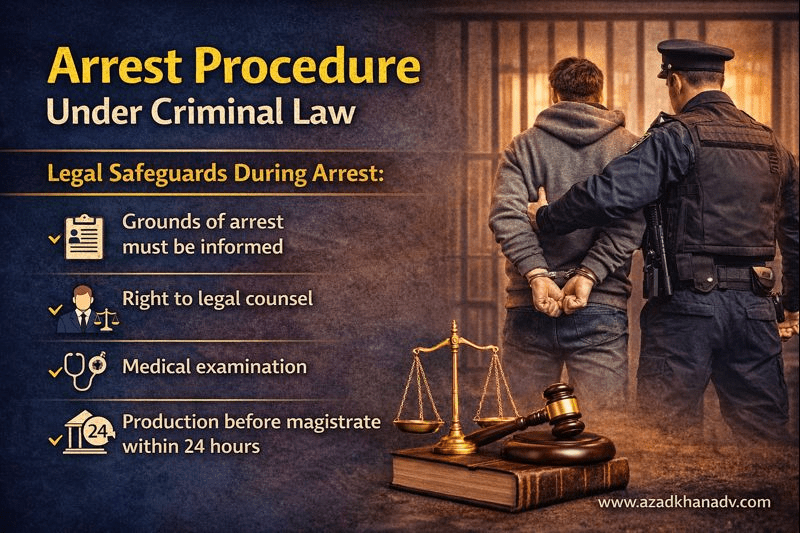
Arrest is a significant exercise of state power and must be carried out strictly in accordance with law. Criminal law in India recognizes that arrest directly affects personal liberty and therefore imposes legal safeguards to prevent abuse.
Under the Code of Criminal Procedure, police may arrest a person in cognizable offences without a warrant. However, arrest is not mandatory in every case. Courts have emphasized that arrest should be based on necessity, not mere suspicion.
Legal Safeguards During Arrest:
- Grounds of arrest must be informed
- Right to legal counsel
- Medical examination
- Production before magistrate within 24 hours
Despite safeguards, misuse of arrest powers remains a concern. This is why searches related to anticipatory bail meaning and anticipatory bail definition are common. Anticipatory bail in India acts as a shield against unjustified arrest, particularly in cases of false allegations.
Courts, including the Allahabad High Court, strictly monitor arrest procedures and grant relief where personal liberty is threatened. Consulting an experienced Anticipatory Bail Advocate in Allahabad ensures that legal remedies are exercised promptly.
Legal professionals like Advocate Azad Khan, widely recognized as an Allahabad High Court best criminal advocate, play a crucial role in protecting individuals from illegal arrest and ensuring that criminal law is applied fairly and lawfully.
16. Rights of an Accused Person
In criminal law, the rights of an accused person are fundamental to ensuring fairness, justice, and protection of personal liberty. The Indian legal system is based on the principle that an individual is presumed innocent until proven guilty. Therefore, criminal law provides several constitutional and statutory safeguards to every accused person.
One of the most important rights is the right to personal liberty under Article 21 of the Constitution. No person can be deprived of liberty except according to procedure established by law. This principle forms the foundation of protections such as bail and anticipatory bail in India.
An accused person also has the right to be informed of the grounds of arrest, the right to consult and be defended by a legal practitioner, and the right to remain silent. Courts have repeatedly held that forced confessions are illegal and violate human dignity.
Key Rights of an Accused:
- Right to legal counsel
- Right to fair trial
- Right against illegal arrest
- Right to anticipatory bail under CrPC
- Right to speedy justice
In cases where false or motivated allegations are anticipated, individuals often seek clarity on what is anticipatory bail in criminal law. Anticipatory bail explained in simple words is a legal protection that prevents arrest before custody, safeguarding dignity and freedom.
To effectively enforce these rights, expert legal assistance is essential. An experienced Anticipatory Bail Advocate in Allahabad, such as Advocate Azad Khan, ensures that accused persons are not subjected to harassment or unlawful detention. His practice before the Allahabad High Court reflects a strong commitment to protecting constitutional rights and upholding justice.
17. Rights of Victims in Criminal Cases
Criminal law not only protects the rights of the accused but also recognizes the rights of victims. Over the years, the Indian criminal justice system has evolved to ensure that victims are treated with dignity, fairness, and compassion throughout the legal process.
Victims have the right to report offences, participate in proceedings, and receive information about the progress of the case. Courts now emphasize victim-centric justice, ensuring that victims are not sidelined during investigation or trial.
One of the most significant rights of victims is the right to compensation, especially in cases involving bodily harm, sexual offences, or death. The criminal courts have the authority to award compensation independently of the outcome of the trial.
Key Rights of Victims:
- Right to fair investigation
- Right to be heard during proceedings
- Right to legal assistance
- Right to compensation and protection
While criminal law balances victim rights with accused rights, procedural safeguards such as anticipatory bail in India ensure that justice is not compromised by unlawful arrest. Courts carefully assess both perspectives before granting relief.
Legal professionals play an important role in maintaining this balance. An experienced criminal advocate ensures that victim rights are respected while safeguarding legal procedure. Practitioners like Advocate Azad Khan, recognized as an Allahabad High Court best criminal advocate, have handled complex criminal cases where both victim justice and constitutional safeguards were equally important.
18. Types of Punishments Under Criminal Law
Punishment is a core component of criminal law, designed to deter crime, reform offenders, and deliver justice. The Bharatiya Nyaya Sanhita prescribes various types of punishments depending on the severity and nature of the offence.
The most common punishment is imprisonment, which may be rigorous or simple. In serious cases, long-term imprisonment or life imprisonment may be imposed. Fines are also frequently awarded, either independently or along with imprisonment.
Types of Punishments Include:
- Imprisonment
- Fine
- Probation
- Community service
- Capital punishment (rarest of rare cases)
Modern criminal law emphasizes reformative justice, particularly for first-time offenders. Courts increasingly consider rehabilitation and societal reintegration while awarding punishment.
Before punishment is imposed, criminal law ensures procedural safeguards such as fair trial and access to bail. Searches for what is anticipatory bail under CrPC often arise during investigation stages, long before punishment is considered.
An experienced criminal advocate plays a crucial role in ensuring proportional punishment and fair sentencing. Advocates like Advocate Azad Khan, practicing before the Allahabad High Court, effectively represent clients in sentencing and bail matters, ensuring that criminal law is applied humanely and constitutionally.
19. Role of Police in Criminal Law
The police play a critical role in the enforcement of criminal law. Their responsibilities include maintaining law and order, registering FIRs, investigating offences, arresting accused persons, and collecting evidence for prosecution.
While police are empowered to act swiftly, their authority is not absolute. Criminal law places legal checks on police powers to prevent misuse. Arrest, search, and seizure must comply strictly with legal procedures.
Key Functions of Police:
- Registration of FIR
- Investigation of offences
- Arrest of accused
- Filing of charge sheet
Misuse of arrest powers has been a recurring concern, which is why legal remedies like anticipatory bail in criminal law exist. Courts have repeatedly emphasized that arrest should be the exception, not the rule.
Individuals often search for anticipatory bail explained in simple words when fearing police action based on false complaints. Anticipatory bail under CrPC acts as a safeguard against unnecessary harassment.
The role of a skilled Anticipatory Bail Advocate in Allahabad becomes crucial in such cases. Legal professionals like Advocate Azad Khan, widely regarded as an Allahabad High Court best criminal advocate, ensure that police actions are legally scrutinized and constitutional rights are protected.
20. Role of a Criminal Advocate

A criminal advocate is the backbone of the criminal justice system, responsible for protecting legal rights, ensuring fair trials, and upholding constitutional principles. From investigation to trial and appeal, a criminal advocate guides clients through every stage of criminal proceedings.
One of the most crucial responsibilities of a criminal advocate is protecting personal liberty. In cases involving potential arrest, understanding what is anticipatory bail in criminal law becomes vital. Anticipatory bail in India allows individuals to secure legal protection before arrest, preventing humiliation and unlawful detention.
Key Responsibilities of a Criminal Advocate:
- Legal consultation and strategy
- Representation before police and courts
- Filing bail and anticipatory bail applications
- Safeguarding constitutional rights
Choosing the right advocate can significantly impact the outcome of a criminal case. Individuals facing serious allegations often look for an experienced Anticipatory Bail Advocate in Allahabad who understands local court practices and High Court jurisprudence.
Advocate Azad Khan, known as an Allahabad High Court best criminal advocate, has extensive experience handling criminal cases, including anticipatory bail, regular bail, and trial advocacy. His expertise ensures that criminal law is used as a shield for justice, not a weapon for harassment.
Conclusion
Criminal law is a powerful framework designed to maintain order, protect rights, and deliver justice. From understanding basic concepts to exercising remedies like anticipatory bail, legal awareness empowers individuals to safeguard their liberty. In complex situations, consulting an experienced criminal advocate ensures lawful protection and peace of mind.
FAQs
1. What Is Anticipatory Bail in Criminal Law?
Anticipatory bail is a legal protection that allows a person to seek bail before arrest when there is a reasonable apprehension of being arrested in a criminal case. It is granted under Section 438 of the CrPC to protect personal liberty.
2. What Is the Meaning and Definition of Anticipatory Bail?
The anticipatory bail meaning refers to pre-arrest bail granted by a court.
Anticipatory bail definition: It is a judicial direction to release a person on bail in the event of arrest, ensuring they are not taken into police custody unnecessarily.
3. When Can Anticipatory Bail Be Applied in India?
Anticipatory bail can be applied before arrest when a person has a genuine fear of arrest in a non-bailable offence, especially after FIR registration or when false implication is anticipated.
4. Who Can Apply for Anticipatory Bail Under CrPC?
Any person who apprehends arrest in a non-bailable criminal offence can apply for anticipatory bail under CrPC, even if the FIR has not yet been registered.
5. What Is the Difference Between Bail and Anticipatory Bail?
The key difference lies in timing:
- Bail is applied after arrest
- Anticipatory bail is applied before arrest to prevent detention
6. Is Anticipatory Bail Applicable in All Criminal Cases?
No. Anticipatory bail is generally not granted in extremely serious offences where custodial interrogation is necessary. Grant depends on facts, seriousness of offence, and judicial discretion.
7. What Is the Anticipatory Bail Process in India?
The anticipatory bail process in India includes:
- Filing an application under Section 438 CrPC
- Explaining apprehension of arrest
- Court hearing and conditions, if granted
8. How Long Does Anticipatory Bail Remain Valid?
Anticipatory bail may be granted:
- For a limited duration, or
- Till the conclusion of trial,
depending on court orders and case circumstances.
9. Why Should I Hire an Anticipatory Bail Advocate in Allahabad?
An Anticipatory Bail Advocate in Allahabad understands local police practices and Allahabad High Court procedures, which significantly improves the chances of timely legal relief.
10. Why Is Advocate Azad Khan Considered One of the Best Criminal Advocates in Allahabad High Court?
Advocate Azad Khan is known for strong criminal defence practice, High Court expertise, and successful handling of anticipatory bail and criminal cases, earning recognition as an Allahabad High Court best criminal advocate.