
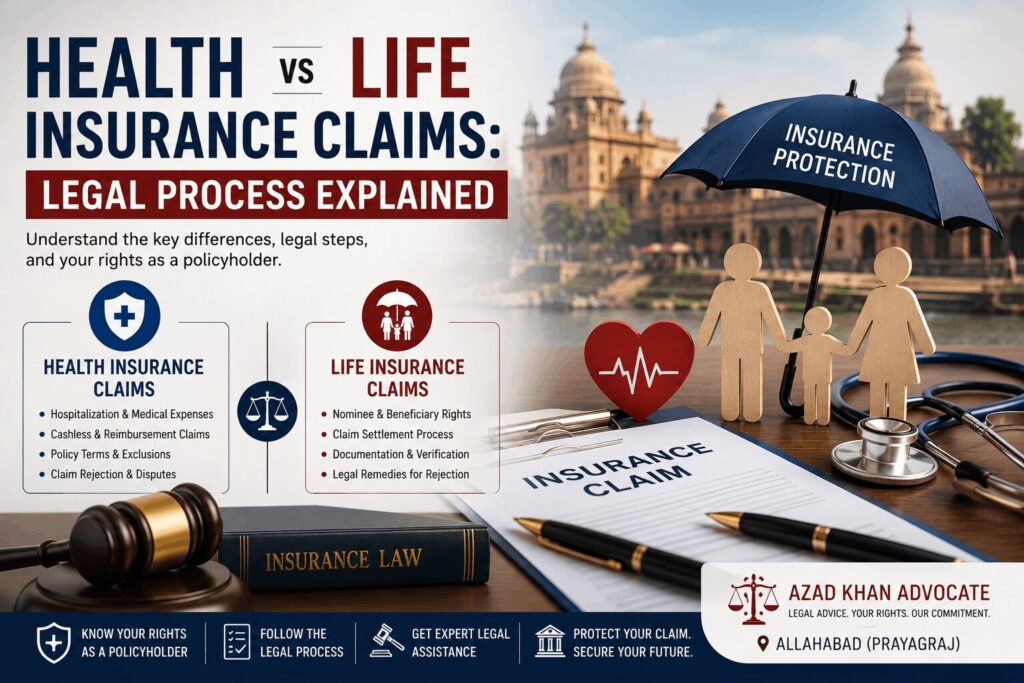
Health vs Life Insurance Claims: Legal Process Explained
Health and life insurance claims are legally different processes. A health insurance claim is filed for treatment costs and is usually settled or rejected within weeks; a nominee files a life insurance claim after the policyholder’s death and involves a longer verification process. Both can be legally challenged if wrongly denied through the insurer’s grievance cell, the Insurance Ombudsman, or a civil/consumer court if needed.
Insurance is supposed to be a safety net. In practice, many families in Allahabad discover the real complexity of their policy only at the exact moment they need it most – during a medical emergency or after losing a loved one. Understanding how health and life insurance claims actually work, and what your legal options are when a claim is denied, can be the difference between getting the compensation you’re owed and giving up on it.
Health Insurance Claims vs. Life Insurance Claims: What’s the Difference?
Although both are “insurance claims,” they follow different timelines, documentation, and dispute processes.
| Health Insurance Claim | Life Insurance Claim | |
| Who files it | The policyholder (or hospital, for cashless claims) | The nominee or legal heir, after the policyholder’s death |
| When it’s filed | At the time of treatment/hospitalization | After the insured person’s death |
| Typical settlement time | 15–30 days for cashless/reimbursement claims | 30–90 days, longer if under investigation |
| Common rejection reasons | Pre-existing condition non-disclosure, policy exclusions, incomplete documentation | Suicide clause (within first year), non-disclosure at policy purchase, nominee disputes |
| Where disputes are raised | Insurer’s grievance cell → Insurance Ombudsman → Consumer Court | Insurer’s grievance cell → Insurance Ombudsman → Civil/Consumer Court |
Types of Health Insurance Claims
- Cashless claims – the hospital bills the insurer directly (only at network hospitals)
- Reimbursement claims – you pay first and claim the amount back afterward
Types of Life Insurance Claims
- Death claims – filed by the nominee after the insured’s death
- Maturity claims – filed by the policyholder when the policy term ends
- Survival benefit claims – periodic payouts under certain policy types
Common Reasons Insurance Claims Get Rejected
For Health Insurance
- Non-disclosure of a pre-existing condition at the time of purchasing the policy
- Treatment falling under a policy exclusion (certain conditions have waiting periods)
- Incomplete or inconsistent documentation between the hospital and the claim form
- Claim filed after the policy’s notification deadline
- Hospital not empanelled for cashless treatment, without prior notice to the insurer
For Life Insurance
- Death within the first year, flagged under the suicide clause – this doesn’t automatically void a claim, but it triggers additional scrutiny.
- Non-disclosure of health conditions or habits (smoking, pre-existing illness) at the time of buying the policy
- Dispute over who the rightful nominee or legal heir is
- Death occurring under circumstances the insurer classifies as excluded (certain high-risk activities, for instance)
- Alleged misrepresentation of age, income, or occupation on the original application
Many of these rejections are technically valid under the policy wording – but a significant number are wrongful denials that insurers issue knowing that most claimants won’t push back. That’s exactly where legal support changes the outcome.
The Legal Process for Disputing a Rejected Insurance Claim
Step 1: Request the Rejection Letter in Writing
Insurers are required to provide a written reason for denial. This document is the starting point for any dispute – informal phone reassurances from an insurance agent are not.
Step 2: File a Complaint with the Insurer’s Grievance Redressal Cell
Every insurer is required to have an internal grievance mechanism. This is the fastest and often first successful step, especially when the rejection is based on a documentation error rather than a genuine policy exclusion.
Step 3: Escalate to the Insurance Ombudsman
If the grievance cell doesn’t resolve the issue, or the claim amount falls within the Ombudsman’s jurisdiction, you can file a formal complaint with the Insurance Ombudsman – a free, faster alternative to court for many disputes.
Step 4: File a Consumer Complaint or Civil Suit
For larger claim amounts, disputed nominee cases, or where the Ombudsman process doesn’t resolve the matter, a consumer complaint (under the Consumer Protection Act) or a civil suit becomes the next step. This is where legal representation matters most – insurers typically have legal teams defending these claims, and a well-documented, well-argued case makes a measurable difference to the outcome.
Step 5: Legal Notice and Negotiation
In many cases, a formal legal notice from an advocate prompts the insurer to reconsider before the matter even reaches a hearing – insurers often prefer to settle a well-documented, legally supported claim rather than litigate it.
How a Lawyer Helps at Each Stage
- Reviewing the rejection letter and policy wording to determine whether the denial is legally sound or challengeable
- Compiling and organizing medical, financial, and policy documentation to strengthen the claim
- Drafting the Ombudsman complaint or consumer court filing with the correct legal grounds
- Representing you in negotiations, Ombudsman hearings, or court proceedings
- Handling nominee and legal heir disputes in life insurance death claims, where multiple family members may have competing claims
Real-World Scenarios
A cashless claim rejected over a technicality. A patient’s cashless health insurance claim is denied because the hospital’s paperwork listed a slightly different diagnosis code than the original policy documentation – a clerical mismatch, not a genuine exclusion. With the right escalation through the grievance cell and, where needed, the Ombudsman, this kind of rejection is often reversible.
A life insurance claim delayed over a nominee dispute. A policyholder passes away, and two family members separately claim to be the rightful nominee due to an outdated nomination form. The insurer withholds payment until the dispute is resolved. Legal support here focuses on establishing the valid nominee or legal heir promptly, so the family isn’t left waiting indefinitely during an already difficult time.
Frequently Asked Questions
Q1. What is the difference between a health insurance claim and a life insurance claim?
A health insurance claim covers medical treatment expenses and is filed by the policyholder during or after treatment. The nominee files a life insurance claim after the policyholder’s death and involves a separate verification and claim settlement process.
Q2. Can an insurance company reject a claim without giving a reason?
No. Insurance companies are required to provide a written explanation for rejecting a claim. This rejection letter is important if you intend to challenge or dispute the insurer’s decision.
Q3. What is the Insurance Ombudsman, and when should I approach them?
The Insurance Ombudsman is a free grievance redressal authority that handles insurance-related disputes. You can approach the Ombudsman if your complaint has not been satisfactorily resolved by the insurer’s grievance cell and your claim falls within the Ombudsman’s jurisdiction.
Q4. How long do I have to file a complaint against a rejected claim?
The time limit depends on the insurer and the forum where the complaint is filed. For example, complaints to the Insurance Ombudsman generally must be submitted within a specified period after receiving the insurer’s final response. It is advisable to act promptly instead of delaying after receiving the rejection letter.
Q5. Can a rejected health insurance claim still be approved later?
Yes. Many health insurance claim rejections result from documentation issues or policy interpretation. These decisions can often be challenged successfully through the insurer’s grievance cell, the Insurance Ombudsman, or the consumer court with proper legal guidance.
Q6. What happens if there’s a dispute over who the rightful nominee is for a life insurance claim?
If there is a dispute regarding the rightful nominee or legal heir, the insurance company generally withholds the claim payment until the matter is resolved through mutual settlement or a legal determination.
Q7. Do I need a lawyer to file an insurance claim dispute?
No, hiring a lawyer is not required to file a complaint with the insurer’s grievance cell. However, legal representation can significantly improve your chances of success during proceedings before the Insurance Ombudsman or consumer courts, where insurers are usually represented by legal professionals.
Conclusion – Don’t Accept a Rejected Claim as Final
A denied health or life insurance claim isn’t always the end of the road – it’s often the start of a process most people don’t realize they have the right to pursue. Whether it’s a technical rejection on a hospital claim or a delayed life insurance payout tied up in a nominee dispute, understanding the legal process – and having the right support at each stage – makes a real difference to the outcome.
Azad Khan Advocate represents clients across Allahabad and Prayagraj in health and life insurance claim disputes, from grievance escalation to Ombudsman complaints and consumer court litigation.
Call or WhatsApp +91 83186 04952 if your insurance claim has been delayed, denied, or underpaid.